Tunisian Reverse Stitch – Free Tunisian Crochet Stitch Tutorial
If you’ve been exploring Tunisian crochet stitches lately, there’s a good chance you’ve run into the Tunisian Reverse Stitch—a beautifully textured stitch that often gets overshadowed by its more well-known counterpart, the Tunisian Purl Stitch. But here’s the fun twist: while it looks a lot like the purl stitch, the Tunisian Reverse Stitch is much easier to work, much faster to swatch, and produces the same cozy, nubby texture we all love.
This post contains affiliate links. At no extra cost to you, I may receive a small commission from purchases made through affiliate links, which helps me to keep bringing awesome free content!
This is the December Stitch for the 2025 New Year New Stitch Crochet Along!
Even better? It has zero curl. None. Not even a whisper of curl trying to sneak in at the edges. It lays perfectly flat every time, which makes it an incredible stitch choice for blankets, scarves, dishcloths, garments, and just about any project where structure and drape matter.
Today, we’re diving deep into what makes the Tunisian Reverse Stitch special, how it works, and why you may find yourself using it in place of the Tunisian Purl Stitch in your design plans (I know I do!).
What is Tunisian Crochet?
Tunisian crochet is a unique fiber art technique that blends the best of both worlds—crochet and knitting. Like crochet, it’s worked with a single hook, but instead of completing each stitch right away, you keep a row of loops on your hook—similar to knitting. The result is a beautifully textured fabric that feels dense, warm, and full of character.
Tunisian crochet is worked using special crochet hooks, called Tunisian Crochet Hooks, and much like knitting, you can get straight Tunisian hooks or circular Tunisian hooks. However, smaller projects, like 6″ afghan squares, can be worked on a traditional crochet hook! It just needs to be a plain hook with no special handle or grip.
What is the Tunisian Reverse Stitch?
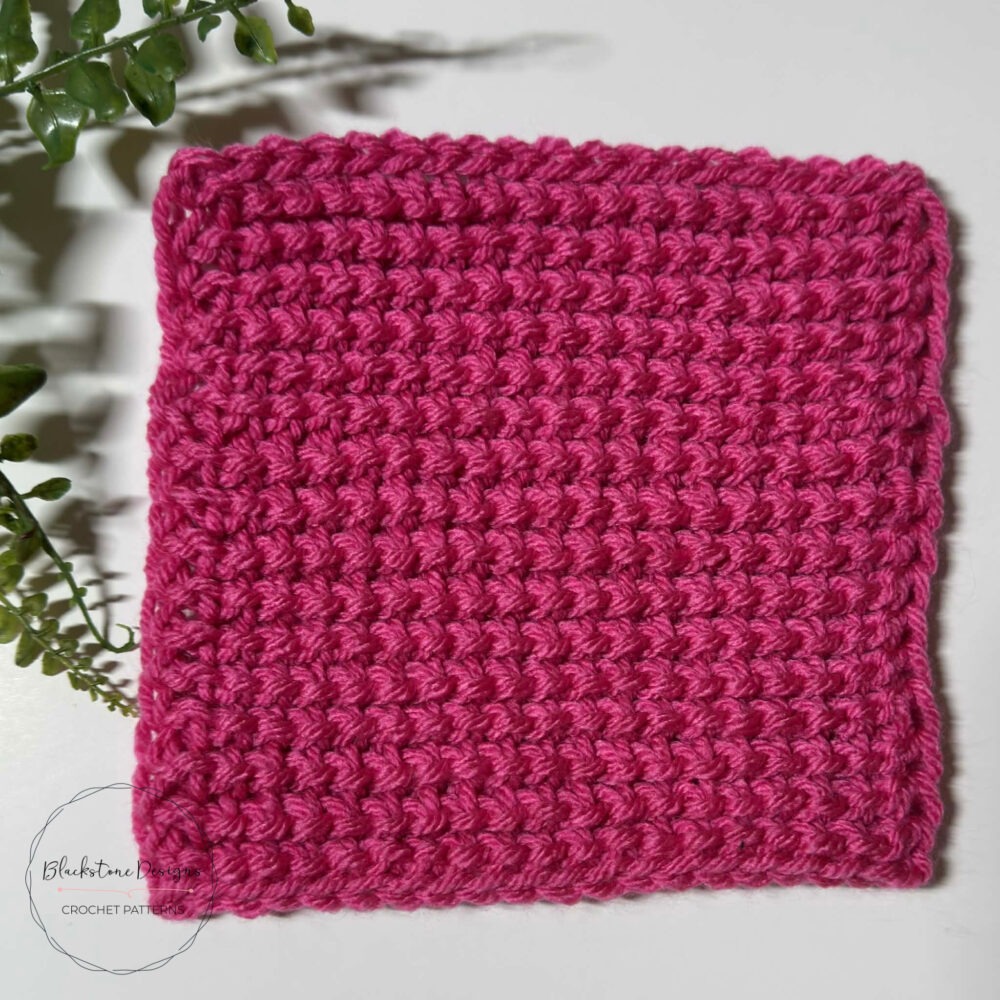
The Tunisian Reverse Stitch—often abbreviated as TRS—is a beginner-friendly Tunisian crochet stitch that creates a textured, knit-inspired fabric. Instead of working across the front of the fabric like many Tunisian stitches do, the Reverse Stitch is worked from behind the vertical bars, which is where it gets its name.
Because of this back-to-front motion, you get a fabric with the same subtle bumps and character you’d see in the Tunisian Purl Stitch, but with far less hand movement and no yarn wrapping required. If you enjoy the look of purl stitches but don’t love the slower rhythm of creating them, the Reverse Stitch is going to feel like a dream.
It’s smooth, rhythmic, and incredibly satisfying—especially when you start seeing how quickly the rows build.
Why add the Tunisian Reverse Stitch to the Crochet Along?
The Tunisian Reverse Stitch is visually very similar to the Tunisian Purl Stitch, so why add it to the crochet along when we already have the TPS? Because a lot of stitch patterns use the TRS, so I thought it made sense to add this beginner stitch to the arsenal! It’s a great way to get more comfortable with the anatomy of a Tunisian stitch and although they are similar, up close the TRS looks like a TSS and TPS combined, so they have different uses.
Why Crocheters Love the Tunisian Reverse Stitch
There are a lot of reasons crocheters (myself included!) come back to this stitch again and again. Here are the biggest highlights:
Very Similar Look to the Tunisian Purl Stitch
One of the most noticeable features of the Reverse Stitch is that it mimics the appearance of Tunisian purls. It has that same textured, horizontal bump that adds visual interest and depth to your work.
But unlike the Tunisian Purl Stitch, which requires holding on the front side of the fabric, the Reverse Stitch is mechanically simple. You just insert your hook from behind the vertical bar and pull up a loop—no extra steps, no awkward hand positioning, no slowing down your flow.
Because of that, I often use the Tunisian Reverse Stitch in place of the purl stitch in stitch patterns or design schemes. It gives you the look without the extra effort.
Much Easier (and Faster!) to Work Than the Purl Stitch
The Tunisian Purl Stitch is beautiful, but let’s be honest—it can take a little patience and extra maneuvering.
The Reverse Stitch, on the other hand, is quick. You can swatch an entire square in a fraction of the time, and the motion becomes mindlessly repetitive in the best way. If you love speed without sacrificing texture or structure, this is the stitch for you.
Naturally Lays Flat — No Curling at All
Curling is one of the most common challenges in Tunisian crochet. Many beloved stitches curl like crazy until you block them or surround the edges with alternating stitches.
Not the Tunisian Reverse Stitch.
It lays perfectly flat right off the hook.
A Great Beginner Stitch
Even if someone is brand new to Tunisian crochet, the Reverse Stitch is a gentle learning curve. It teaches hook placement, tension control, and directional awareness without overwhelming a newcomer with extra movements.
Plus, the instant reward of a flat, uniform fabric is a big motivator to keep going.
Project Ideas
The Tunisian Reverse Stitch is one of those stitches that quietly becomes a go-to. It’s versatile, beginner-friendly, beautifully textured, and lays perfectly flat—which means you can use it in everything from garments to home décor without worrying about curling edges or complicated stitch patterns.
Here are some project ideas where the Tunisian Reverse Stitch really shines:
Scarves and Cowls
Since this stitch naturally lies flat and has a soft, pebbled texture, it creates scarves and cowls that drape beautifully while still feeling warm and cozy. The subtle bumps add visual interest without overwhelming the design, making it perfect for everyday accessories.
Sweaters and Cardigans
Because the stitch has structure without stiffness, it works incredibly well for lightweight garments. Panels made with the Reverse Stitch hold their shape, seam neatly, and offer a comfortable, wearable feel. It’s an excellent option for cardigans, vests, sweater panels, and even yokes that need consistency and clean edges.
Home Décor
This stitch really shines in home décor projects. The flat, uniform fabric is ideal for blankets, pillows, table runners, placemats, or any project that needs clean, stable edges. The texture adds just enough personality to make pieces look polished and intentionally crafted.
Hats and Beanies
The Reverse Stitch gives hats a soft, textured body without the bulk you sometimes see in other Tunisian stitches. It’s great for modern beanies, slouch hats, or even structured caps where you want warmth but also clean lines.
Bags and Purses
Since the stitch doesn’t curl and works up into a sturdy, balanced fabric, it’s a fantastic choice for totes, handbags, project bags, and small accessories. When paired with cotton or other stable yarns, the stitch holds up beautifully and gives bags a modern, minimalist texture.
Yarn and Hook Pairings
Yarn choice can completely change the feel and personality of the Tunisian Reverse Stitch, even though the stitch itself tends to work up soft, flexible, and naturally flat. Depending on the fiber you choose, you can lean into more structure, more drape, or more texture—making TRS a great match for a wide range of projects.
Here’s how different yarn types behave with the Tunisian Reverse Stitch:
Cotton
Cotton gives you crisp stitch definition and clean texture. It’s perfect for dishcloths, washcloths, coasters, placemats, and any project where you want durability and structure without curl.
Acrylic
Acrylic produces a soft, cozy fabric that works beautifully for scarves, blankets, beanies, and garments. It’s easy to work with and ideal for beginners practicing the stitch.
Wool Blends
Wool blends add warmth, elasticity, and a touch of luxury. They’re wonderful for wearable pieces like sweaters, cardigans, shawls, and even textured cowls.
Bamboo or Linen Blends
These fibers add lightweight softness and a silky drape. They’re especially nice for summer tops, lacy wraps, lightweight scarves, or transitional garments where you want breathability.
Pairing it with Other Stitches
Because of its simplicity and versatility, the Tunisian Reverse Stitch is a fantastic addition to stitch combinations and pattern design. If you’re building a fabric that alternates texture—maybe pairing it with the Tunisian Simple Stitch (TSS) or Knit Stitch (TKS) —the TRS blends seamlessly.
It pairs especially well with:
Tunisian Simple Stitch (TSS)
TSS gives you a smooth, traditional Tunisian look, while TRS adds a bumpier contrast. Alternating the two creates a rhythmic texture that works beautifully in dishcloths, blankets, and even garment yokes.
Tunisian Knit Stitch (TKS)
If you’re going for a knit-look fabric but want a little variation, the Reverse Stitch breaks up the rows nicely without disrupting the drape. And of course alternating the stitches creates a ribbed look that’s unique.
Tunisian Purl Stitch
Using Reverse and Purl stitches together creates a reversible look that’s completely identical. And since both TPS and TRS lay flat on their own, so does the combination.
Colorwork
Because the Reverse Stitch produces clean, distinct stitches, it works great for:
- Stripes
- Two-tone textured pieces
- Alternating stitch-and-color motifs
There’s enough definition to make each color switch noticeable without looking busy.
How to get the Tunisian Reverse Stitch pattern:
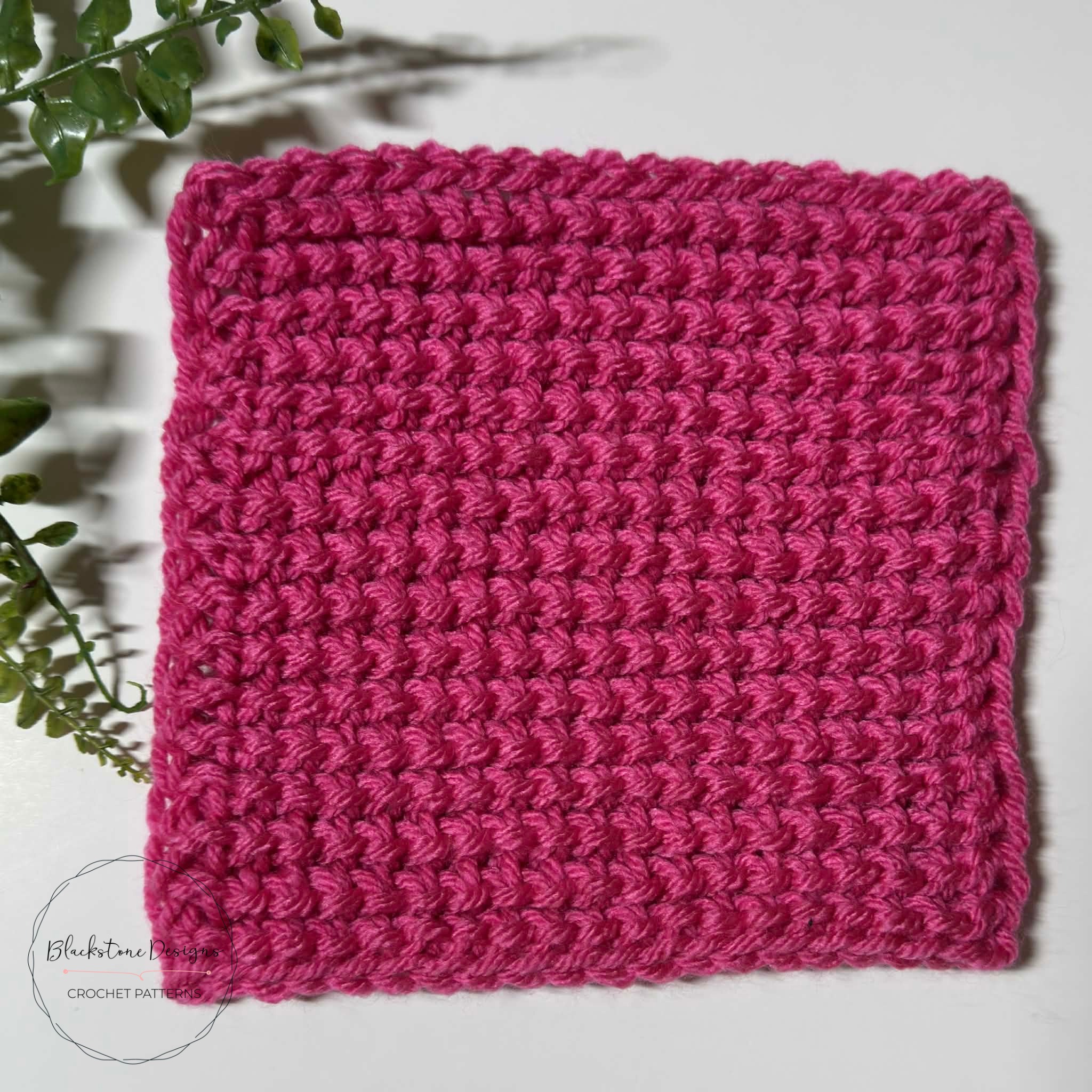
Tunisian Reverse Stitch Afghan Square Pattern
Option 1: Continue scrolling for free pattern instructions on this site
Option 2: Get the PDF download free through December 2025!
Option 3: Purchase the ad-free PDF that includes tutorial photos from one of my shops
What materials are needed for the afghan square?
If you’re following along with the 2025 New Year New Stitch CAL, we’re making afghan squares to assemble into a blanket at the end of the year. The Tunisian Reverse Stitch is the December Stitch. For this afghan square you will need worsted weight yarn and a K/10.5/6.50mm Tunisian Crochet Hook. I am using 100% acrylic yarn and since I’m making 6″ squares, I am also able to use a traditional crochet hook.
Let’s learn the Tunisian Reverse Stitch:

Materials
Worsted Weight Yarn (#4)
- 6” = .7oz/40yds
- 12” = 2.8oz/150yds
- 15” = 4.5oz/235yds
Gauge
14 TRS sts x 12 rows = 4”
Finished Measurements
Block to 6”(12”,15”)
Stitch Guide
ch = chain
TSS = See Special Stitches
sl st(s) = slip stitch(es)
YO = yarn over
Skill Level
Confident Beginner
PATTERN WRITTEN IN U.S. TERMS
Pattern Notes
- This square is worked from bottom to top.
- Where asterisks appear, repeat the instructions between them.
- This pattern is worked in multiples of 2+2; the instructions are written for a beginning ch-24 for a 6” square, ch-48 for a 12” square, and ch-54 for a 15” square.
- To work a gauge swatch, chain 16 then work pattern below for 13 total rows.
- Stitch chart is on the last page.
Special Stitches
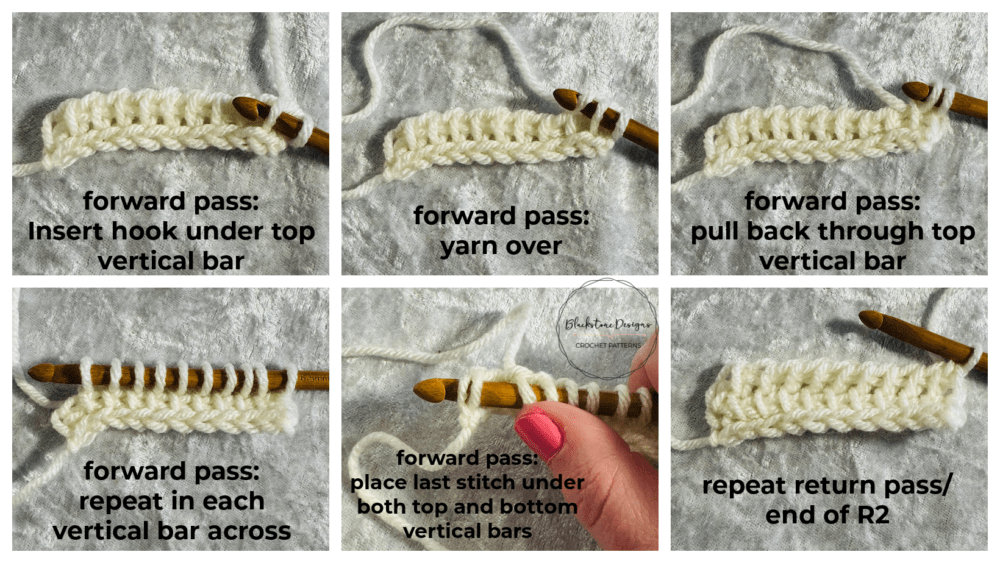
Tunisian Simple Stitch (TSS) = Insert hook from right to left under the front vertical bar of stitch, yarn over, pull back under vertical bar.
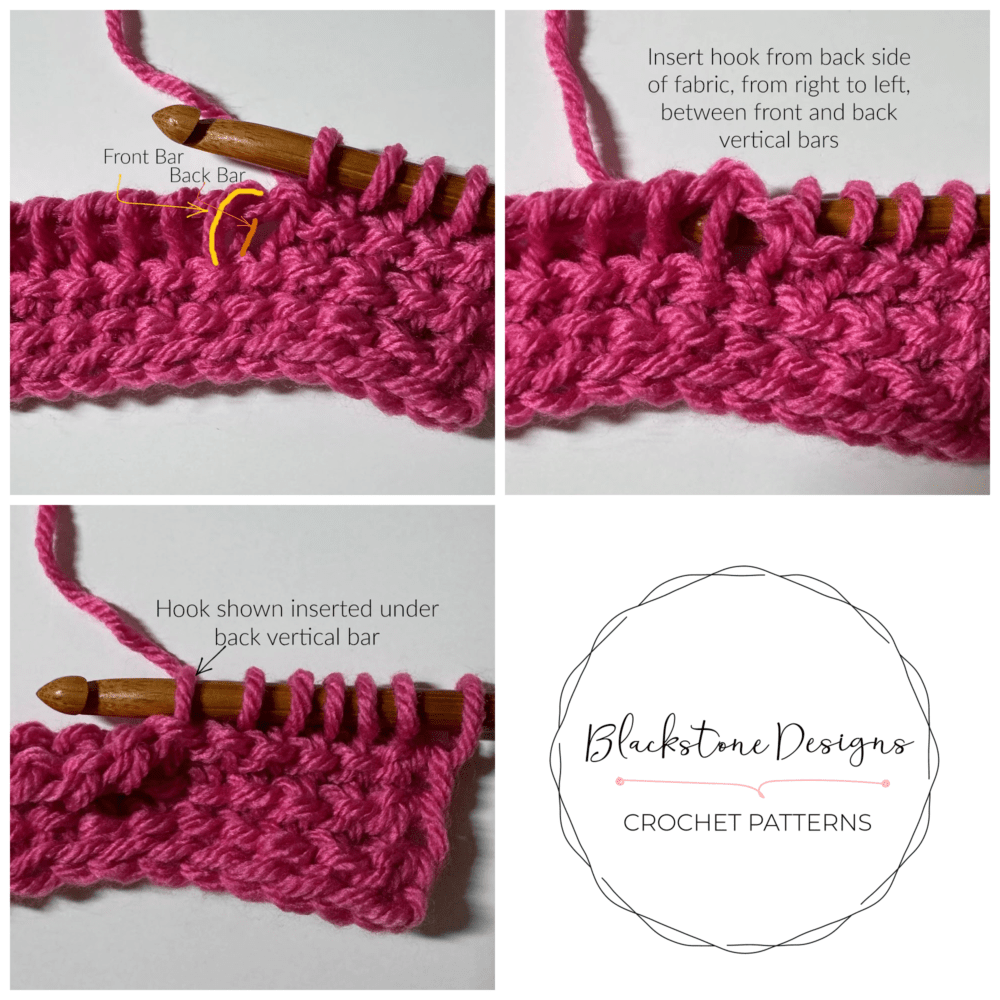
TSS Bind Off (Bind Off) = Insert hook from right to left under the front vertical bar of stitch, yarn over, pull back under vertical bar and through the loop on the hook (i.e. slip stitch): *skip 1st TSS, TSS in next, TSS in skipped stitch* across.
Instructions
R1.
Forward Pass: Working in the back bump of the chain across:
Ch 24(48,54), insert hook in 2nd ch from hook, draw up a loop, *insert hook in next ch, draw up a loop* across
Return Pass: Yarn over, pull through 1 loop on hook, *YO, pull through 2 loops on hook* across until one loop remains
R2.
Forward Pass: 1st loop on hook counts as 1st st, so skip 1st vertical bar: *skip 1st TSS, TSS in next, TSS in skipped stitch* across; for last stitch place hook under both front and back vertical bars, YO, pull through both loops.
Return Pass: Yarn over, pull through 1 loop on hook, *YO, pull through 2 loops on hook* across until one loop remains
Repeat R2 (Fwd & Rtn Pass) until fabric measures 5 ¾ – 6” (11 ¾ – 12”, 14 ¾ – 15”)
R3. Bind off.
R4. Turn project over to face back side, sl st in the end of each row and in each stitch arnd; Fasten.

Finishing
- Block to 6” x 6” (12” x 12”, 15” x 15”) as needed.
- Hide all strings.
And that’s how you work the Tunisian Reverse Stitch!
The Tunisian Reverse Stitch is one of those secretly powerful stitches that can completely transform your Tunisian crochet experience. It’s simple, dependable, textured, flat, and quicker to work than the Tunisian Purl Stitch—making it an easy favorite for crocheters who value both form and function.
If you’re building your Tunisian stitch library or participating in a year-long Tunisian Crochet Along, this stitch is a fantastic one to add to your toolbox.
Happy Tunisian Crocheting!
Written pattern and photographs © 2025 Sonya Blackstone of Blackstone Designs. Do not sell, share, or modify this pattern, but instead share the link to where the pattern can be found. You may sell items you make with this pattern. This pattern, as with all Blackstone Designs/Sonya Blackstone patterns, are not for educational use without written permission from the designer. All rights reserved.
Sonya Blackstone is a participant in the Amazon Services LLC Associates Program, an affiliate advertising program designed to provide a means for us to earn fees by linking to Amazon.com and affiliated sites.